If you live in the Pacific Northwest, you already know — rain is a fact of life. Western Washington averages over 37 inches of rainfall annually, and that water has to go somewhere. When it pools on your driveway, parking lot, or walkways, it doesn't just sit there looking ugly. It actively breaks down your pavement, shortens its lifespan, and creates safety hazards.
Proper drainage isn't an afterthought. It's one of the most important factors in how long your asphalt or concrete investment will last.
Key Takeaways
- Grading is foundational — A minimum 1-2% slope ensures water moves off the surface before it causes damage
- Standing water destroys pavement — Freeze-thaw cycling, subgrade erosion, and accelerated oxidation all result from poor drainage
- Multiple solutions exist — Trench drains, French drains, catch basins, and permeable paving each address different drainage problems
- Permeable paving reduces runoff — Porous asphalt and pervious concrete let water pass through, but require specific soil conditions and regular maintenance
- Maintenance keeps drainage working — Clear catch basins twice yearly, seal cracks promptly, and monitor for new low spots that develop as pavement settles
Why Standing Water Is Your Pavement's Worst Enemy
Water that sits on paved surfaces causes damage through several mechanisms:
- Freeze-thaw cycling — Even in our relatively mild winters, temperatures around Everett and Snohomish County dip below freezing often enough. Water seeps into tiny cracks, freezes, expands, and forces those cracks wider. Repeat this dozens of times per winter and small cracks become major failures.
- Subgrade erosion — Water that penetrates through cracks reaches the base material underneath. Over time, it washes away the compacted gravel and soil that supports the surface, leading to sinking, potholes, and structural failure.
- Oxidation acceleration — Constant moisture exposure speeds up the oxidation process in asphalt, making it brittle and gray faster than properly drained surfaces.
- Slip hazards — Pooling water on walkways and parking lots creates liability issues, especially during the cooler months when algae and moss growth make wet surfaces dangerously slick.
The bottom line: every dollar you invest in drainage saves you multiple dollars in repairs and premature resurfacing. Good drainage is also one of the most effective ways to extend the life of your commercial parking lot.
The Foundation: Proper Grading and Slope
Before any fancy drainage system gets installed, the surface itself needs to be graded correctly. This is the single most important drainage factor and it happens during initial construction.
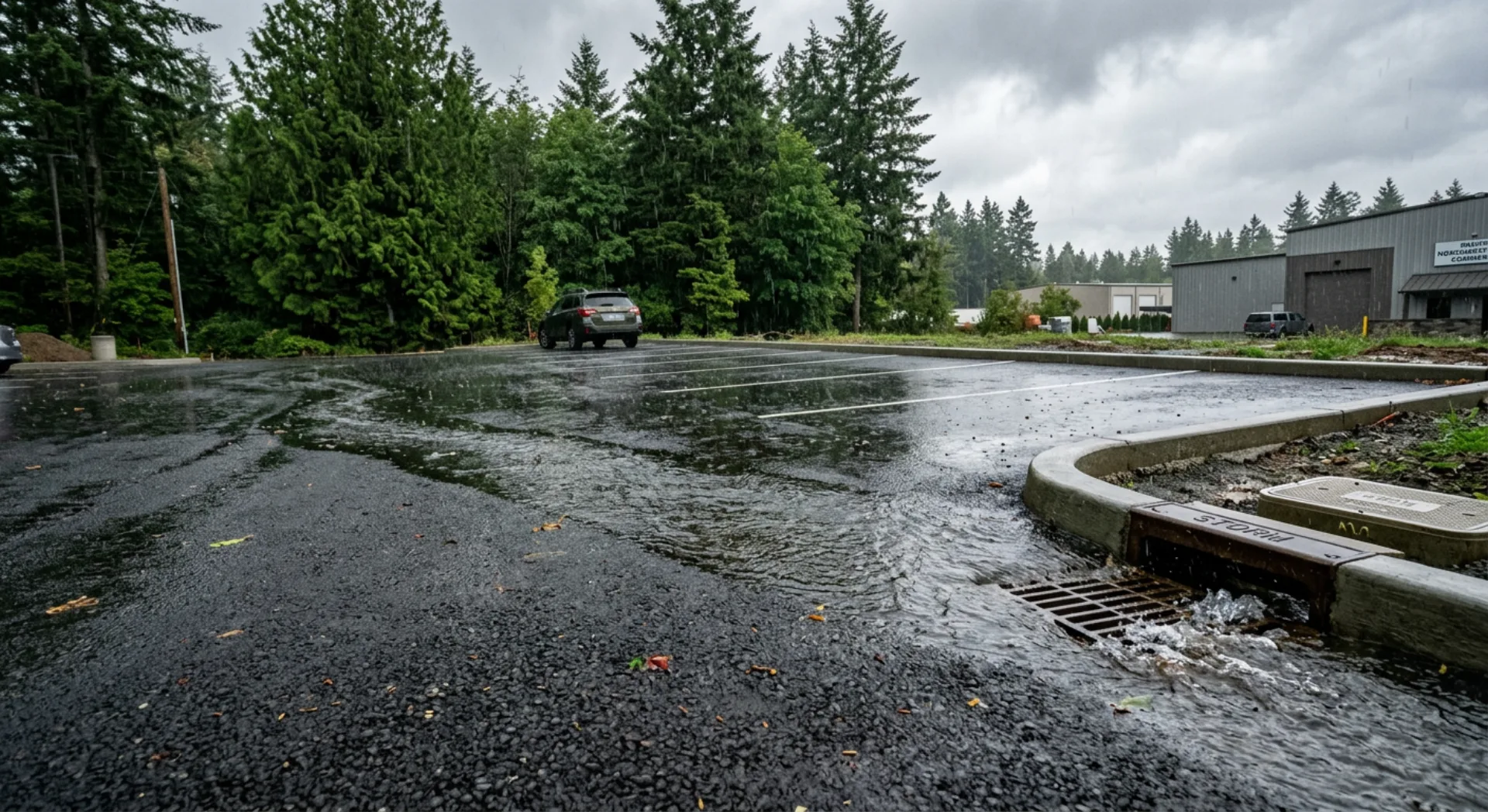
For asphalt parking lots and driveways, the industry standard is a minimum slope of 1-2% — meaning the surface drops 1 to 2 inches for every 10 feet of horizontal distance. This seems subtle, but it's enough to keep water moving toward designated collection points rather than pooling in low spots.
Concrete surfaces typically require similar grades, though the smoother finish means water moves more efficiently even at lower slopes.
Key grading principles:
- Water should always flow away from buildings and structures
- Crown the center of driveways so water sheets to both edges
- Parking lots should direct flow toward perimeter drains or landscape areas
- Avoid creating valleys or dips where water naturally collects
If your existing surface has drainage problems, sometimes regrading or overlay work can correct the slope without a full tear-out.
Trench Drains and Channel Drains
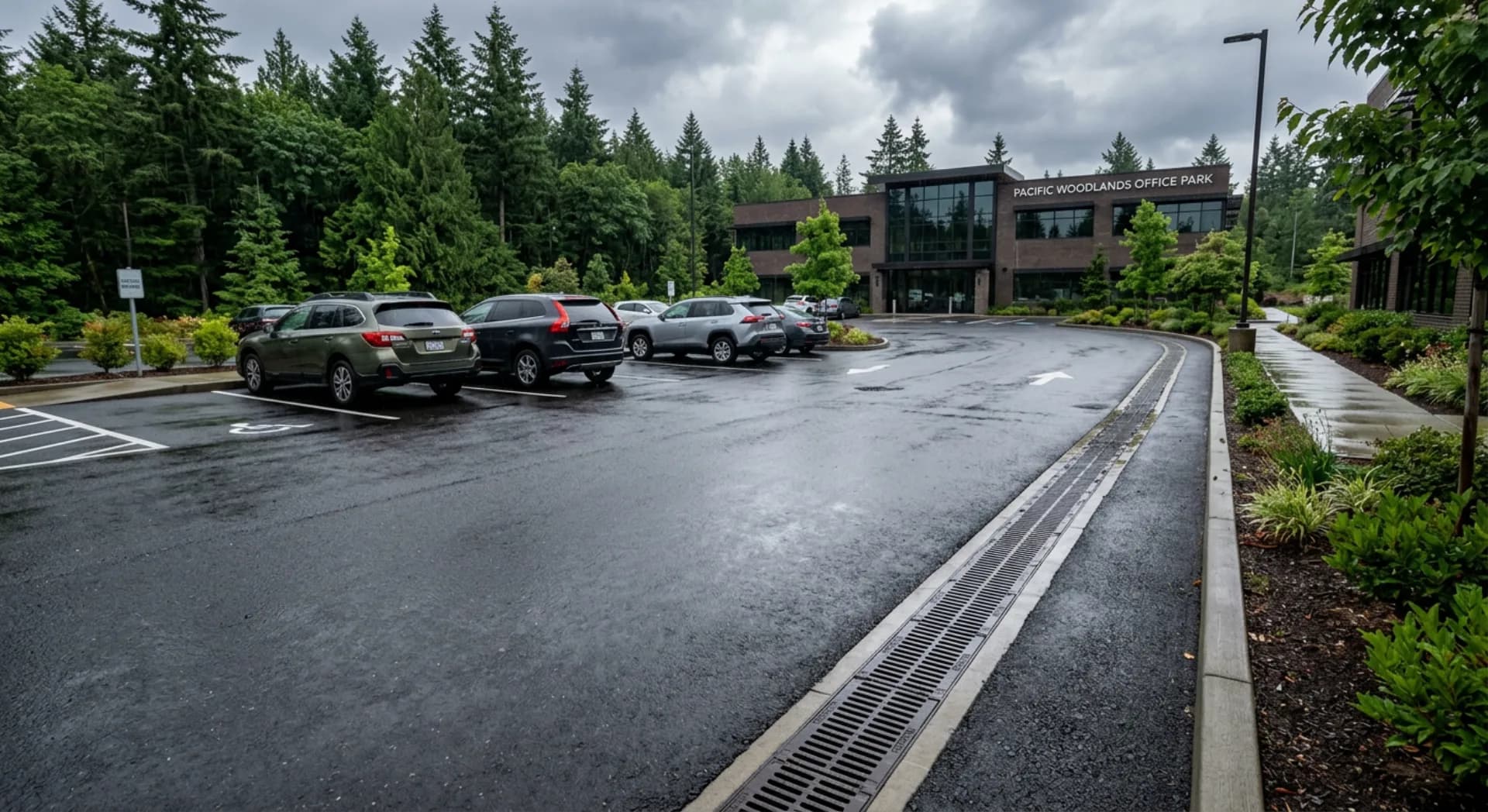
When surface grading alone can't handle the water volume — or when you need to intercept flow at specific points — trench drains (also called channel drains) are the go-to solution.
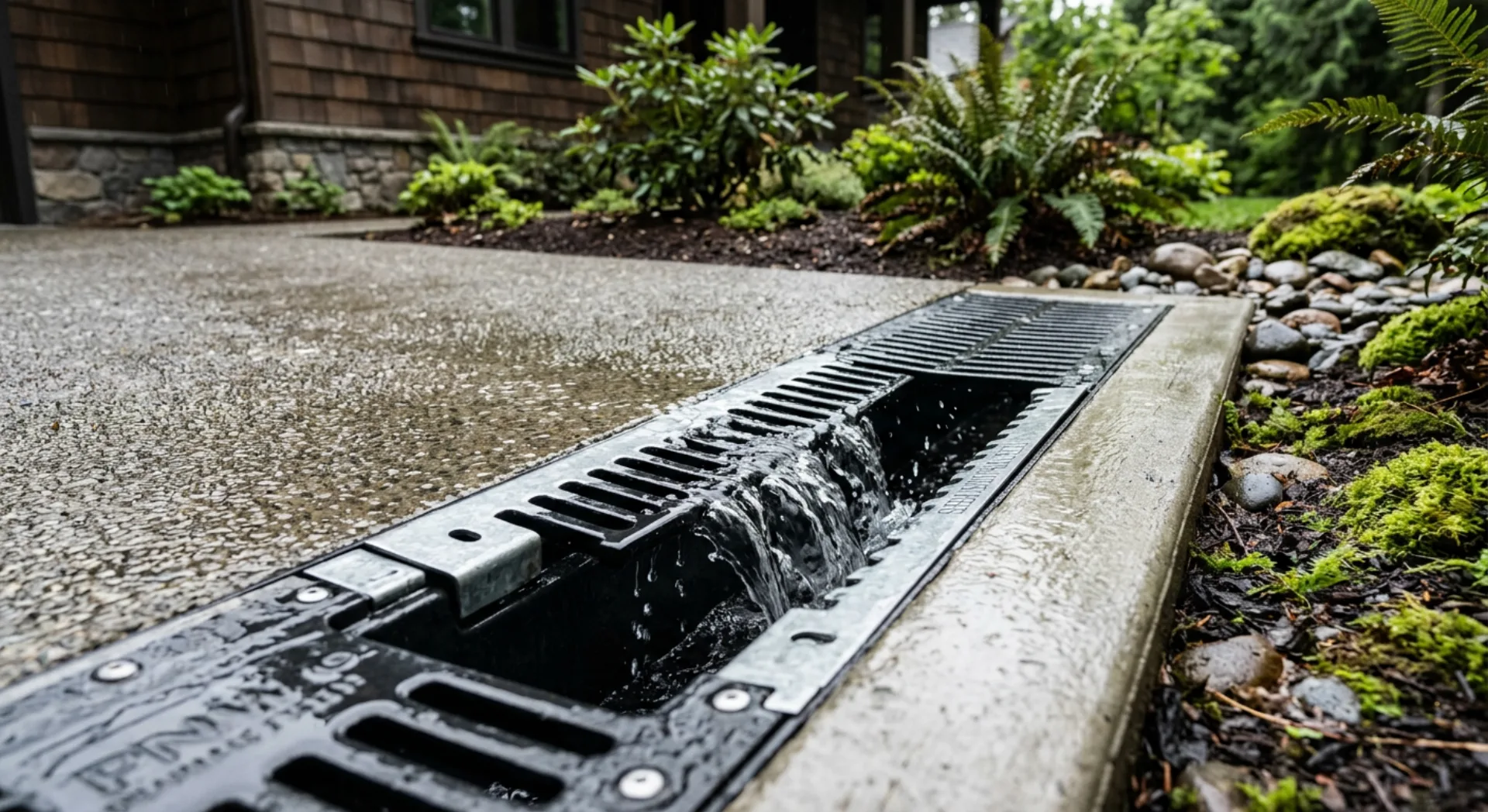
These are narrow channels set flush with the pavement surface, covered by a grate, that collect water along their entire length and channel it to a discharge point. You'll commonly see them:
- At garage entrances — Preventing water from flowing into the garage
- At parking lot entries — Catching sheet flow before it enters the lot
- Along building perimeters — Protecting foundations from runoff
- At the base of sloped driveways — Intercepting water before it reaches the street or a low point
Trench drains come in various materials (polymer concrete, fiberglass, stainless steel) and load ratings. A residential driveway drain has very different requirements than one in a commercial parking lot that handles truck traffic.
Installation matters: A poorly installed trench drain that sits even slightly above the surrounding surface will have water flowing around it instead of into it. The drain needs to be the lowest point in its immediate area, with the pavement sloped toward it on both sides.
French Drains for Subsurface Water
Sometimes the problem isn't just surface water — it's water that's already underground, saturating the soil beneath your pavement. This is especially common in the Pacific Northwest where the water table can be high during our rainy season.
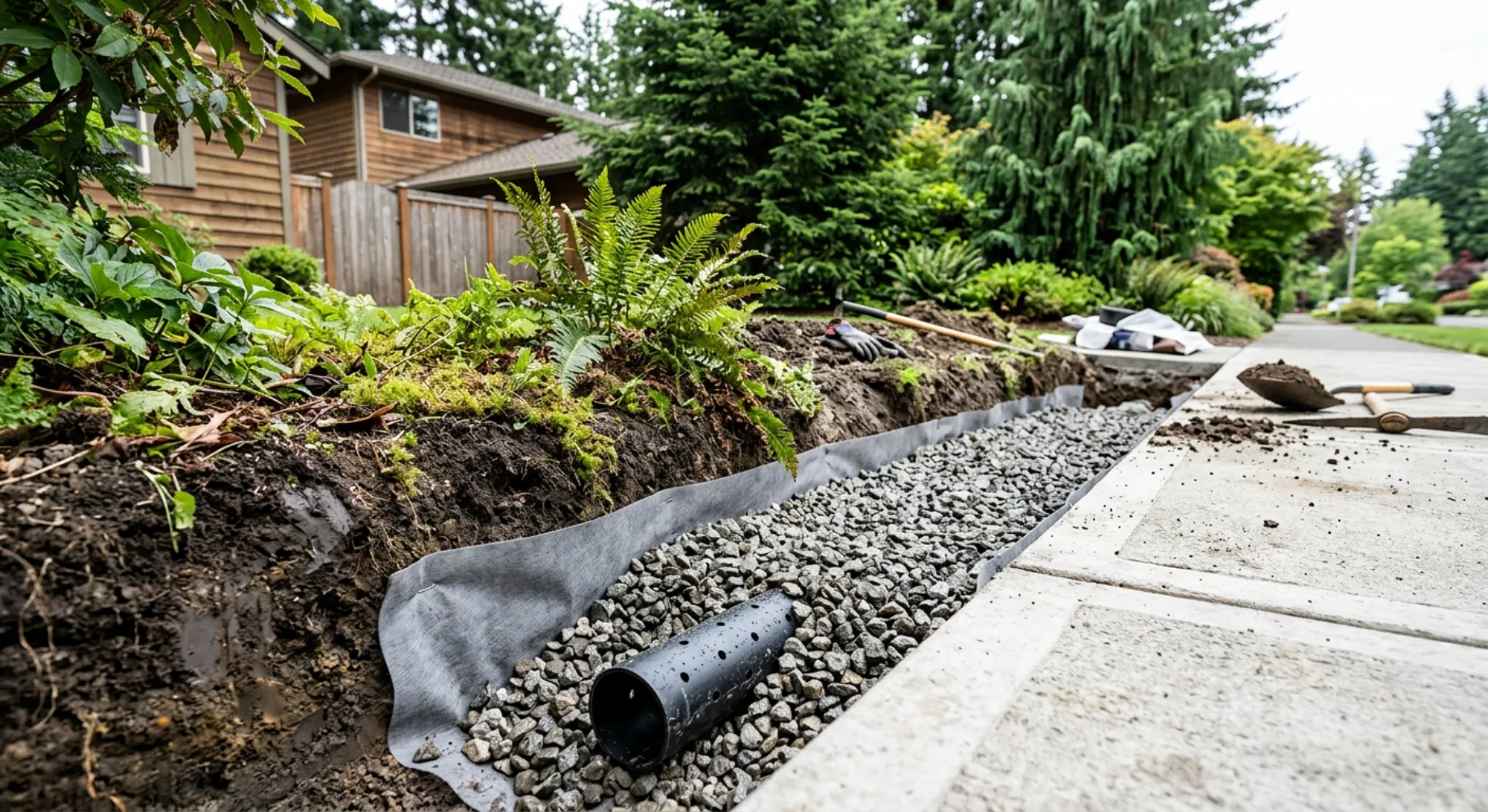
French drains work below the surface. They consist of a perforated pipe surrounded by gravel, wrapped in filter fabric, buried in a trench alongside or beneath the paved area. Groundwater seeps through the gravel, enters the perforated pipe, and is carried away to a designated discharge point.
When you need French drains:
- Your property has a high water table
- You notice the ground around your pavement is consistently soggy
- Water seems to come up through cracks rather than pooling from above
- Your driveway or parking lot is at the bottom of a slope that collects runoff from neighboring properties
French drains are often installed during initial construction but can be retrofitted along the edges of existing pavement. They work particularly well when combined with surface drainage systems for comprehensive water management.
Catch Basins and Area Drains
For parking lots and larger paved areas, catch basins are essential collection points. These are box-shaped structures set into the pavement with a grated top that collect water from the surrounding surface and channel it into underground pipes.
A well-designed parking lot drainage plan uses multiple catch basins positioned at natural low points, connected by underground piping that carries water to the storm drain system or an approved discharge location.
Placement considerations:
- Position at the lowest points of the graded surface
- Space them so no point on the lot is more than 50-75 feet from a drain
- Size them appropriately for the expected water volume
- Include sumps to catch sediment and debris before it enters the piping
Regular maintenance is critical — catch basins need to be cleaned out periodically to remove accumulated sediment, leaves, and debris that reduce their capacity.
Permeable Paving: Letting Water Through
An increasingly popular approach in the Pacific Northwest is permeable paving, which allows water to pass directly through the surface into a specially prepared aggregate base below. This base acts as a reservoir, slowly releasing water into the ground.
Permeable options include:
- Porous asphalt — Looks like standard asphalt but has a modified mix design with reduced fine aggregate, creating interconnected voids
- Pervious concrete — Similar concept applied to concrete, with a coarser aggregate and less paste
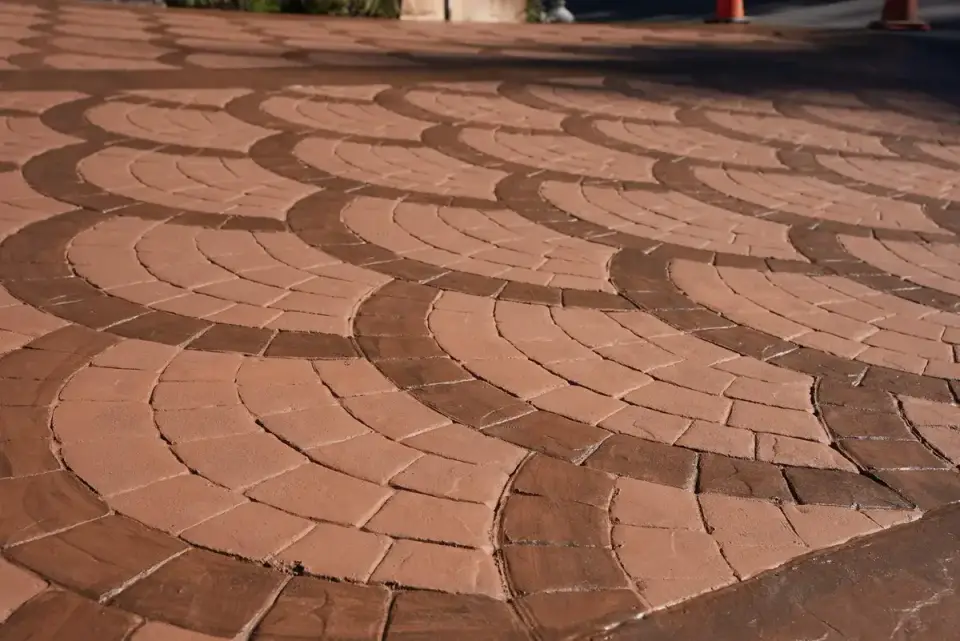
- Permeable pavers — Interlocking units with gaps filled by small aggregate that allows water infiltration
Permeable paving can significantly reduce or eliminate the need for traditional drainage infrastructure. Many Washington municipalities are encouraging or requiring permeable surfaces for new construction to reduce stormwater runoff into local waterways.
However, permeable paving isn't suitable for every situation. It requires specific soil conditions, proper base preparation, and regular maintenance (vacuum sweeping) to keep the pores from clogging.
Maintenance: Keeping Your Drainage Working
Even the best drainage system fails if it's not maintained:
- Clear debris from grates and catch basins at least twice a year (fall and spring are ideal)
- Check for settling around drain structures — pavement can settle over time, creating reverse slopes that direct water away from drains
- Keep sealcoating current on asphalt surfaces to prevent water infiltration through the surface itself — here's how to tell if it's time for sealcoating
- Repair cracks promptly — Every crack is a pathway for water to reach the subgrade
- Monitor for new low spots — Pavement settles over time, and areas that once drained well may develop pooling issues
Frequently Asked Questions
How much does it cost to install a trench drain in a driveway?
A trench drain installation for a residential driveway typically costs $1,500 to $4,000 in the King and Snohomish County area, depending on length, material, and the amount of concrete or asphalt cutting required. Commercial installations with heavy-duty grates and longer runs cost proportionally more.
Can drainage problems be fixed without repaving?
In many cases, yes. Adding trench drains, French drains, or catch basins to an existing surface can resolve pooling issues without a full tear-out. If the problem is caused by settling that has changed the surface grade, a targeted overlay or localized regrading may correct the slope without replacing the entire surface.
What causes standing water on a parking lot?
Standing water results from inadequate slope (less than 1% grade), clogged or undersized drains, pavement settling over time, or original construction that didn't account for proper water flow. In the Pacific Northwest, heavy clay soils can also prevent subsurface drainage, compounding the problem.
Is permeable paving a good option for the Pacific Northwest?
Permeable paving works well in many PNW applications, particularly for low-traffic areas, overflow parking, and residential driveways. The key requirements are suitable soil conditions for infiltration, proper aggregate base construction, and regular vacuum sweeping to prevent pore clogging. Many municipalities actively encourage permeable surfaces to reduce stormwater runoff.
How often should catch basins be cleaned?
Catch basins should be inspected and cleaned at least twice a year — once in early spring after winter debris accumulation and once in late fall before the heavy rain season. High-traffic commercial lots or properties near trees may need quarterly cleaning to maintain full drainage capacity.
When to Call a Professional
Some drainage issues are obvious — you can see the puddles forming every time it rains. Others are more subtle, revealing themselves only through premature pavement deterioration, foundation moisture problems, or erosion along pavement edges.
If you're noticing any of these signs on your property in King or Snohomish County, it's worth getting a professional assessment. The right drainage solution depends on your specific site conditions, soil type, existing infrastructure, and local stormwater regulations.
At Jireh Asphalt & Concrete, we evaluate drainage as part of every paving project. Whether you're planning new construction or dealing with drainage problems on an existing surface, proper water management is the key to pavement that performs for years to come.
Ready to solve your drainage problems? Contact us for a free consultation on your residential or commercial property in the greater Everett and Seattle area.