Your concrete sidewalk does more than connect your property to the street — it shapes first impressions, ensures safe access for visitors, and plays a real role in your property's overall value. But when cracks start spreading, sections begin to heave, or the surface becomes uneven, you're faced with a critical decision: repair or replace?
Choosing the wrong option can mean wasting money on a temporary fix or overspending on work that wasn't necessary. Here's how to evaluate your sidewalk's condition and make the smartest choice for your property in Washington's unique climate.
Key Takeaways
- Repair for isolated damage — Crack sealing, patching, and leveling work best when damage is limited to one or two panels with a stable subgrade
- Replace for widespread failure — When 30%+ of panels are damaged, the sidewalk is 20+ years old, or tree roots have disrupted the base, replacement is more cost-effective
- Freeze-thaw accelerates problems — Washington's winter temperature swings widen cracks quickly, so early intervention saves money
- ADA compliance drives decisions — Commercial properties with uneven sidewalks face liability risks and may be required to replace rather than patch
- Subgrade condition is key — Surface damage may hide deeper problems; a professional assessment reveals whether the issue is cosmetic or structural
Signs Your Sidewalk Needs Attention
Before deciding between repair and replacement, you need an honest assessment of the damage. Here are the most common warning signs that your concrete sidewalk is due for professional work:
- Hairline cracks — Small surface cracks that haven't spread deep into the slab
- Spalling or flaking — Surface concrete peeling away in layers, exposing aggregate underneath
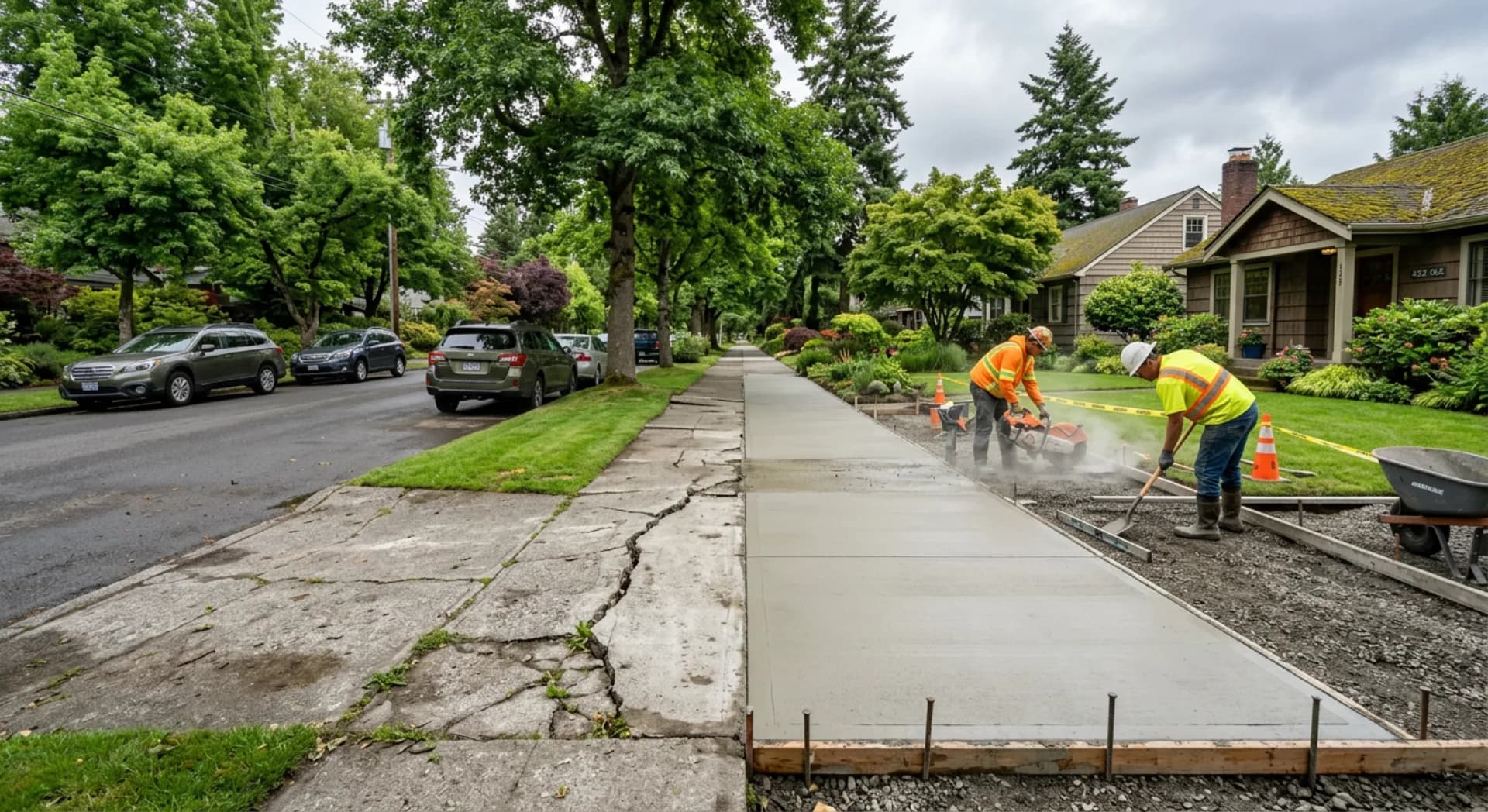
- Heaving or sinking — Sections that have shifted vertically, creating trip hazards
- Tree root damage — Roots pushing up from below, cracking or lifting entire panels
- Wide structural cracks — Cracks wider than a quarter inch that run through the full depth of the slab
- Drainage pooling — Water collecting on or around the sidewalk due to grade changes

If you're noticing one or two hairline cracks, you're likely in repair territory. But if multiple panels are affected, or if the damage involves structural shifting, replacement may be the more practical path forward.
When Repair Makes Sense
Concrete repair is the right call when the damage is cosmetic or contained to a small area. Common repair methods include:
Crack filling and sealing — For cracks under a quarter inch wide, professional-grade sealants prevent water infiltration and stop the damage from spreading. This is especially important in Washington, where freeze-thaw cycles during late fall and early spring can turn small cracks into big problems fast.
Concrete patching — When surface damage like spalling or shallow chipping affects the top layer but the slab underneath is still structurally sound, patching restores the surface without removing the entire panel.
Leveling (mudjacking or foam lifting) — If a section has sunk due to soil settlement but the concrete itself is intact, lifting it back to grade is far less disruptive than tearing it out and pouring new.
Repair is your best option when:
- Damage is limited to one or two panels
- Cracks are narrow and haven't reached the slab's full depth
- The base and subgrade are still stable
- The sidewalk is relatively new (under 15 years old)
- You need a quick turnaround with minimal disruption
When Replacement Is the Better Investment
Sometimes repair is just delaying the inevitable. Full sidewalk replacement makes more sense when the damage is widespread or structural. Here's when to consider it:
Extensive cracking across multiple panels — If more than 30-40% of your sidewalk sections show significant damage, patching each one individually becomes impractical. A full replacement gives you a uniform, long-lasting result.
Severe heaving or root damage — When tree roots have fundamentally disrupted the subgrade, simply lifting or patching the concrete won't solve the underlying problem. Replacement allows the contractor to address root barriers and re-compact the base properly.
Age-related deterioration — Concrete sidewalks in the Pacific Northwest typically last 25-30 years with proper maintenance. If yours is approaching that range and showing its age, replacement provides decades of worry-free performance.
ADA compliance issues — If your sidewalk serves a commercial property or public-facing area, uneven surfaces and trip hazards can create liability. Replacement ensures you meet current accessibility standards (check our ADA compliance guide for more details).
Pacific Northwest Climate Considerations
Washington's climate plays a significant role in how your concrete performs — and how you should approach repairs:
Moisture is the biggest enemy. The Puget Sound region receives 35-50 inches of rain annually. Water seeps into cracks, saturates the subgrade, and causes erosion beneath the slab. This is why sealing cracks early matters so much here. Proper drainage solutions are critical for protecting any concrete investment in the Pacific Northwest.
Freeze-thaw cycles accelerate damage. While western Washington doesn't experience extreme winters, temperatures regularly dip below freezing from November through March. Water trapped in cracks expands when it freezes, widening the damage with every cycle.
Soil conditions vary widely. King and Snohomish County properties sit on everything from compact glacial till to loose sandy soils. Poor drainage and unstable soils are a leading cause of sidewalk settlement and heaving in our region.
Moss and algae growth on neglected concrete creates slippery surfaces and can accelerate surface deterioration. Regular pressure washing and proper grading help prevent this common Pacific Northwest problem.
The Replacement Process: What to Expect
If you've decided replacement is the right move, here's a general overview of how the process works:
- Assessment and planning — A professional evaluates the full scope, checks the subgrade, identifies any drainage issues, and determines if tree roots or utilities need to be addressed
- Demolition and removal — Old concrete is broken up and hauled away for recycling
- Subgrade preparation — The base is re-graded, compacted, and adjusted for proper drainage
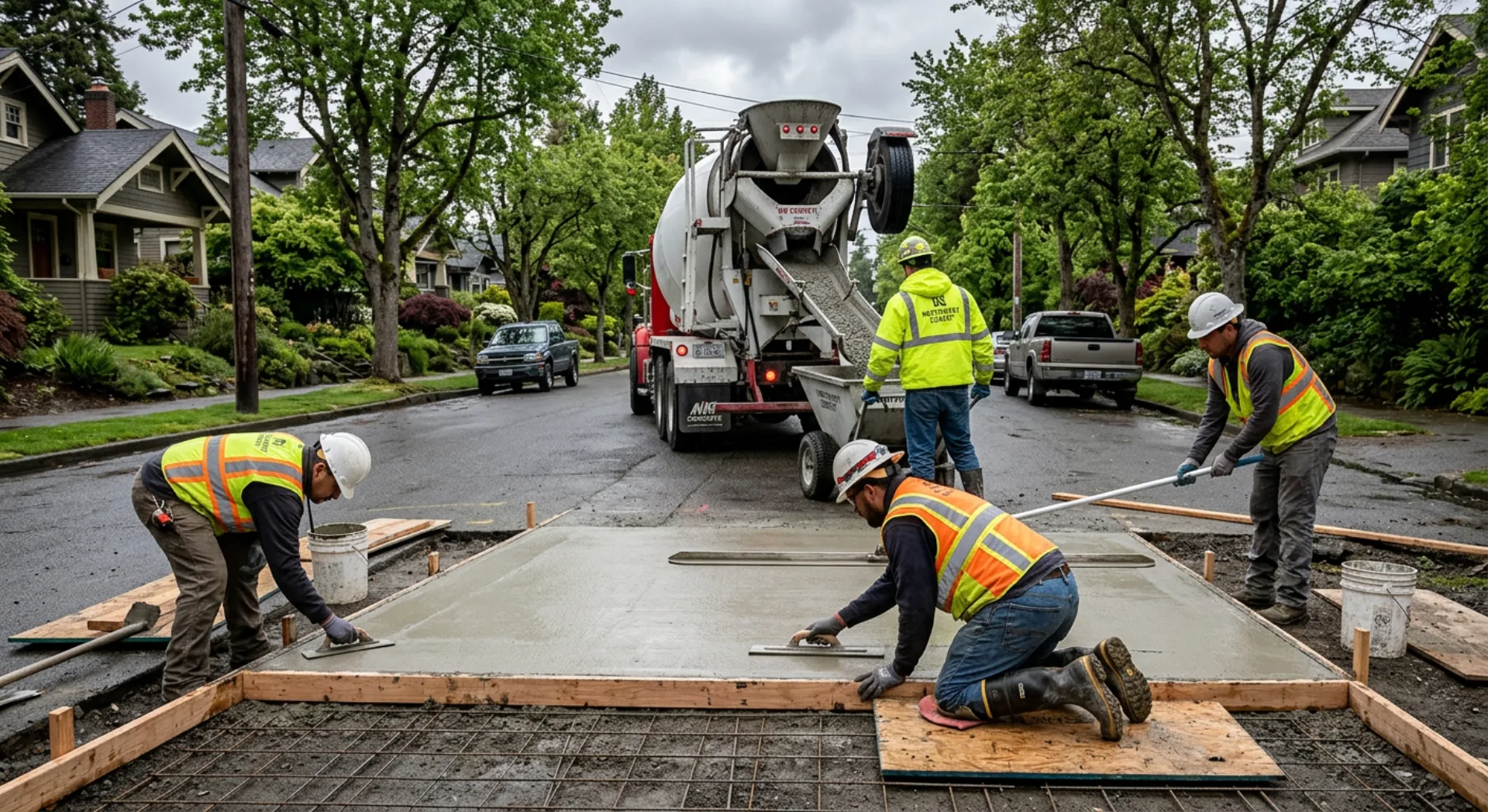
- Forming and pouring — New forms are set to the correct grade and alignment, then fresh concrete is poured and finished (explore concrete flatwork design ideas if you're considering a style upgrade)
- Curing and finishing — Concrete needs adequate cure time (typically 7 days before foot traffic, 28 days for full strength) with proper moisture retention
- Cleanup and restoration — Adjacent landscaping is restored and the site is cleaned up
Making the Right Decision for Your Property
Here's a quick framework to guide your thinking:
Choose repair if:
- Damage is isolated and cosmetic
- The subgrade is stable
- The sidewalk still has years of life left
- You need a fast, targeted fix
Choose replacement if:
- Damage is widespread or structural
- Multiple panels are affected
- The sidewalk is 20+ years old
- You have ADA compliance concerns
- Root or drainage issues need to be addressed at the source
The best approach is always to get a professional assessment. What looks like surface damage might have deeper issues underneath, and what seems like a major problem might be a straightforward repair.
Frequently Asked Questions
How much does sidewalk replacement cost in Washington?
Concrete sidewalk replacement in King and Snohomish County typically costs $8 to $15 per square foot, including demolition, base preparation, and new concrete. Repairs like crack sealing or patching run significantly less — often $3 to $6 per square foot — making them the preferred option when damage is limited.
Is the homeowner or city responsible for sidewalk repair in Washington?
In most Washington municipalities, the adjacent property owner is responsible for maintaining sidewalks along their property, even if the sidewalk is in the public right-of-way. Some cities offer cost-sharing programs for major repairs. Check with your local public works department for specific requirements in your area.
How long does a concrete sidewalk replacement take?
A typical residential sidewalk replacement (removing and replacing 2 to 5 panels) can be completed in one to two days. The concrete needs about 7 days of curing before foot traffic and 28 days for full strength. Larger commercial projects may take several days depending on scope and site conditions.
Can tree roots be removed without damaging the tree?
Selective root pruning is possible when performed by a certified arborist, but removing large structural roots can compromise the tree's stability and health. Root barriers installed during sidewalk replacement help prevent future conflicts by redirecting root growth downward and away from the slab.
What are the signs a sidewalk repair won't last?
If the subgrade is unstable, the slab has heaved more than 2 inches, or cracks extend through the full depth of the concrete, a surface repair is likely to fail within a few years. Multiple previous patches on the same section also suggest the underlying problem hasn't been addressed and replacement is the better investment.
Keep Your Property Safe and Looking Its Best
Whether your sidewalk needs a targeted repair or a complete replacement, addressing the problem early always saves you time and hassle down the road. Cracked, uneven sidewalks aren't just an eyesore — they're a safety concern and, for commercial properties, a potential liability.
At Jireh Asphalt & Concrete, we help property owners across Everett, King County, and Snohomish County make the right call on their concrete work. We'll assess your sidewalk honestly, recommend the most practical solution, and deliver quality results that hold up to Pacific Northwest conditions.
Ready to get your sidewalk evaluated? Contact us today for a free assessment and find out exactly what your property needs.