Asphalt repair is usually appropriate when damage is isolated and the supporting pavement remains sound; replacement becomes the stronger candidate when distress is widespread, recurring, or connected to base and drainage failure.
Reviewed by: Jireh Construction Services editorial team
Last updated: August 10, 2026
This guide is a screening tool, not a diagnosis from a photo. The final scope should follow an on-site review of the surface, base indicators, drainage, traffic, edges, and transitions.
What is the quick way to compare repair and replacement?
| What you observe | What it may indicate | What to evaluate next |
|---|---|---|
| One pothole or a small failed edge | Localized deterioration | Whether a full-depth patch can remove all distressed material |
| A few stable, nonmoving cracks | Surface-level distress | Crack treatment and whether water is reaching the base |
| Interconnected fatigue or “alligator” cracking across a broad area | Repeated loading and possible structural distress | Base condition, affected depth, and whether reconstruction is warranted |
| Ruts, depressions, heaving, or recurring low spots | Movement, deformation, or loss of support | Cause of movement and whether grading or base work is required |
| Water seeping or pumping through cracks | Water moving from below the pavement | Drainage, support-layer erosion, and full-depth investigation |
| Repaired areas that fail again | The original cause may remain | Patch depth, drainage, traffic loading, and base stability |
The Federal Highway Administration’s pavement distress manual separates asphalt distress into cracking, patches and potholes, deformation, surface defects, and water-related conditions. That classification is useful because the pattern and extent of distress matter more than a single crack viewed in isolation.
What counts as asphalt repair?
Repair targets a defined defect while retaining pavement that is still performing. It may include crack treatment, a localized full-depth patch, edge repair, pothole repair, or removal and replacement of a limited failed section.
FHWA describes pothole repair and patching of localized deterioration as corrective maintenance. Its guidance also says fatigue-cracked or potholed material may need to be saw-cut and removed, with deeper excavation considered when the distress reaches the supporting layer. See the FHWA pavement-preservation definitions and FHWA Pavement Design and Development Manual, Chapter 11.
Repair is a reasonable option to evaluate when:
- The failed area is limited and its boundaries can be identified.
- Nearby pavement is firm and does not show widespread fatigue cracking.
- The drainage path works and standing water is not feeding the failure.
- The proposed patch can remove the full depth of distressed material.
- Elevations at garages, curbs, sidewalks, and drains can remain functional.
For help evaluating these conditions, see Jireh’s asphalt paving and repair service.
When should full replacement enter the conversation?
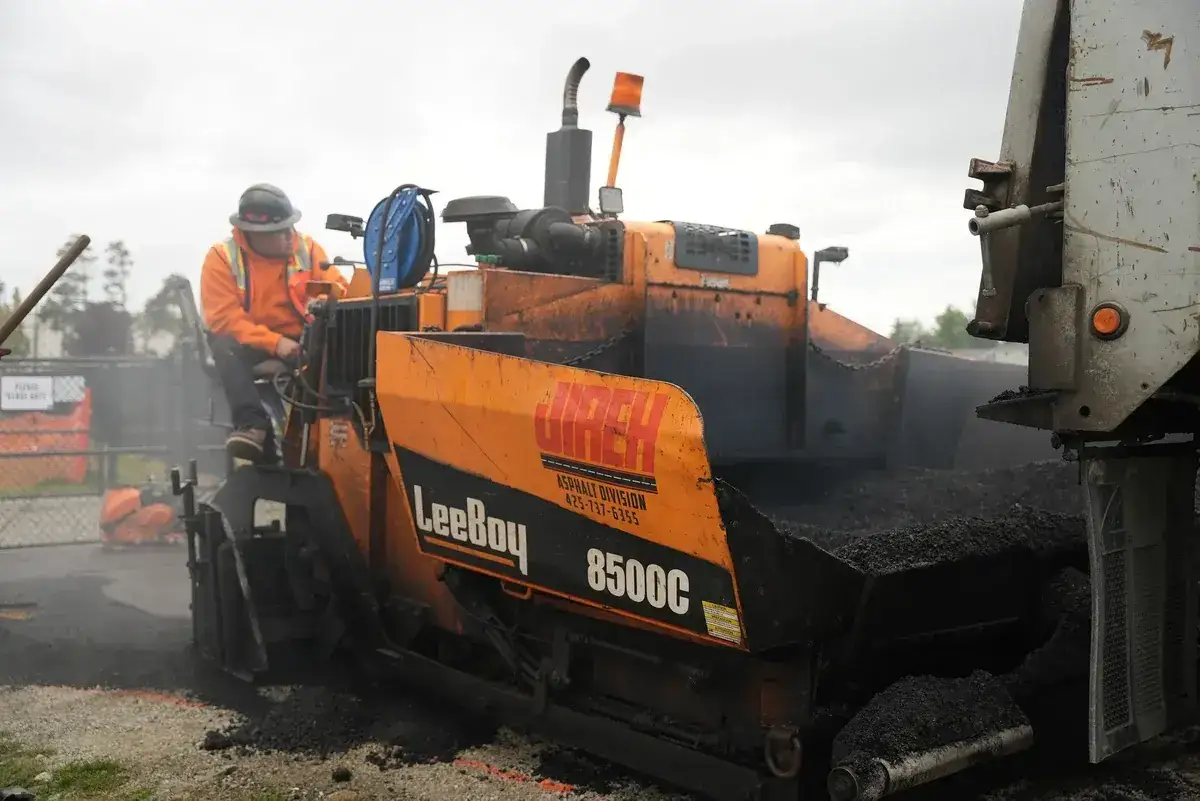
Replacement removes the existing pavement structure in the affected scope and rebuilds the section needed for the site. FHWA defines pavement reconstruction as complete removal and replacement when pavement has failed or become functionally obsolete.
Full replacement deserves closer evaluation when:
- Fatigue cracking is widespread rather than isolated.
- Rutting, heaving, depressions, or soft areas point to movement below the surface.
- Water pumps through cracks or fine material appears at the surface.
- Prior patches repeatedly fail in the same location.
- Drainage grades, elevations, or the underlying section need to be rebuilt.
- The expected vehicle loading no longer matches the existing pavement structure.
An overlay is not automatically a middle-ground solution. FHWA advises against overlays over widespread high-severity cracking or moisture-sensitive pavement and emphasizes completing necessary repairs before an overlay.
Why does drainage change the repair-versus-replacement decision?
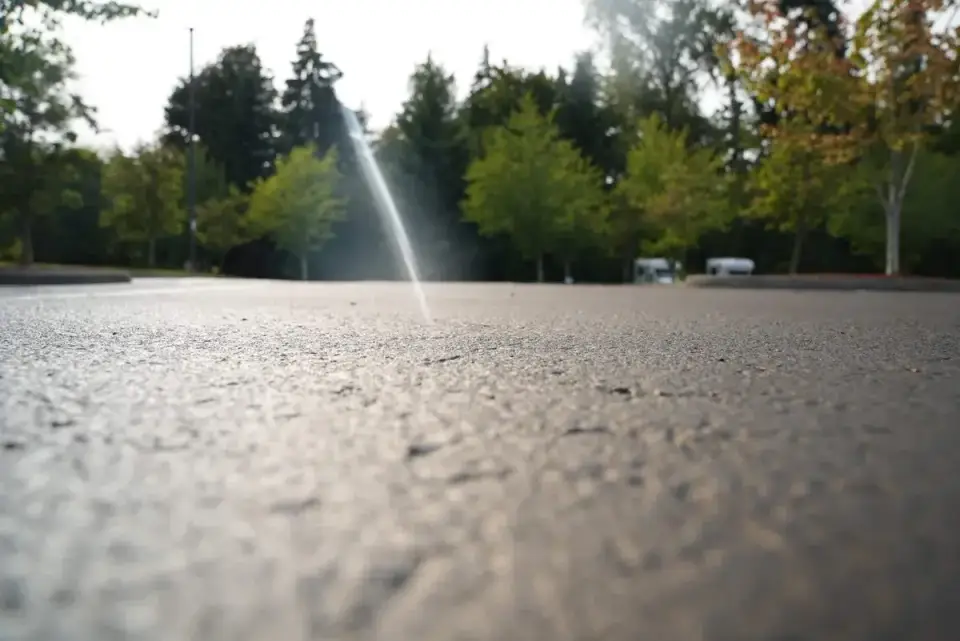
Water can turn a surface symptom into a support-layer problem. FHWA defines water bleeding and pumping as water seeping or ejecting from below pavement through cracks, sometimes carrying fine material from the supporting layers.
Before choosing a surface treatment, check:
- Where roof, landscape, and uphill runoff enter the paved area.
- Whether water reaches a drain or approved discharge path.
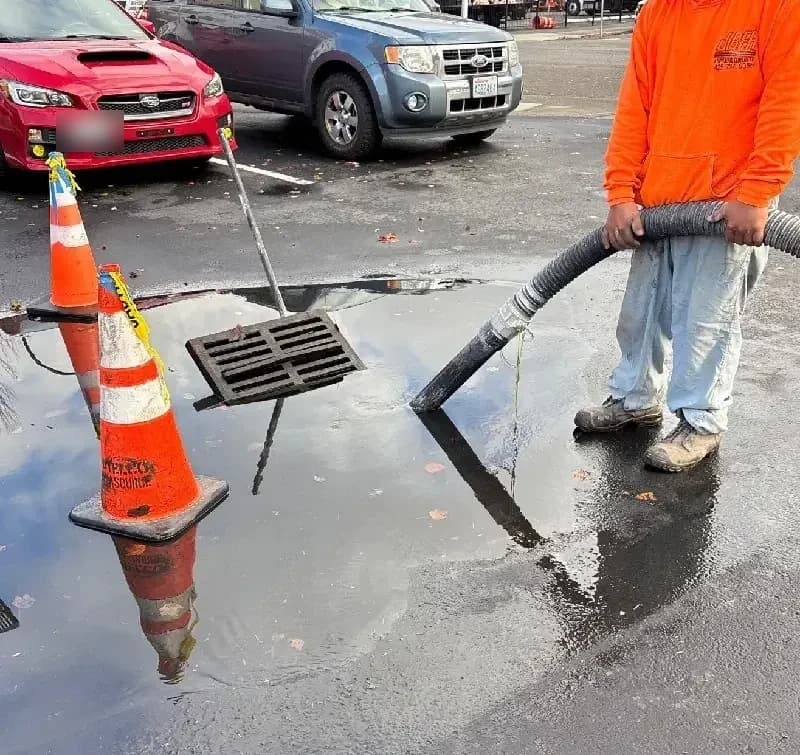
- Whether catch basins, trench drains, or pipes are blocked.
- Whether low spots appeared after settlement.
- Whether failed edges allow water into the base.
If the drainage system is part of the problem, catch basin cleaning may be one part of the corrective plan. Paving over an unresolved water path can leave the cause in place.
What should an asphalt site assessment include?
A useful assessment documents more than appearance:
- Distress map: location, type, and extent of cracks, potholes, ruts, and patches.
- Surface and edge condition: loose material, failed joints, shoulder drop-off, and transitions.
- Drainage review: flow direction, standing water, inlets, outlets, and signs of pumping.
- Support indicators: soft spots, settlement, heaving, and recurring failures.
- Use conditions: passenger vehicles, delivery traffic, turning, braking, and staging.
- Elevation constraints: doors, curbs, sidewalks, utilities, and drainage structures.
- Access plan: how the property will remain safe and usable during the work.
Testing or exploratory excavation may be appropriate when the visible surface does not reveal the condition below. The needed investigation depends on the site; it should not be assumed from age alone.
Which factors affect scope and cost without using a generic price?
The scope is driven by measurable site conditions rather than a universal price per square foot:
- Total area and the percentage that is actually distressed.
- Depth of removal and amount of base correction.
- Drainage or grading changes.
- Access for equipment, hauling, and material delivery.
- Traffic control and phasing requirements.
- Utility covers, curbs, walks, and building transitions.
- Disposal and recycling logistics.
- Required permits, inspections, or right-of-way coordination.
A useful estimate should state the treatment area, removal depth or repair approach, base assumptions, drainage work, paving scope, access plan, and exclusions. If subsurface conditions are unknown, that uncertainty should be identified rather than hidden behind an unsupported fixed range.
Could an asphalt project need an Everett permit?
Permit needs depend on the address and scope. Work involving a driveway apron, curb cut, public right-of-way, grading, drainage, or other public infrastructure should be checked with the City of Everett Permit Services before construction.
Everett also publishes current Design and Construction Standards covering driveways, parking lots, and storm and surface water. The City—not a contractor or this article—makes the final permit determination.
Frequently asked questions
Can a pothole be repaired without replacing the entire driveway?
Often, yes, when the failure is localized and all distressed material can be removed. The surrounding pavement, supporting layer, and water source still need to be checked so the repair addresses the cause as well as the opening.
Does alligator cracking always mean total replacement?
Not automatically. Its location, severity, extent, loading, and underlying support must be evaluated. A limited failed area may support a full-depth localized repair, while widespread fatigue cracking can point toward a broader structural solution.
Will sealcoating fix structural cracks or low spots?
No. Sealcoating is a preventive surface treatment; it does not rebuild a failed base, restore grade, or close active structural movement. Review sealcoating services only after needed pavement and drainage repairs are identified.
Is pavement age enough to decide?
No. Age is context, but condition, loading, drainage, base support, prior work, and elevation constraints determine the appropriate scope.
What is the next practical step?
Document the problem after rain, mark recurring failures, note vehicle use, and gather any prior paving or drainage records. Then request a site-specific comparison that explains what can remain, what should be removed, how drainage will be handled, and which assumptions affect the estimate.
Request an asphalt estimate for a property-specific repair-versus-replacement review.